
In this article
Articles in this category
Home » Inserting a nasogastric tube, how do you do that?
Inserting a nasogastric tube
What is tube feeding?
Tube feeding is liquid food that contains all the nutrients you need on a daily basis, such as:
- Carbohydrates
- Proteins
- Fats
- Vitamins
- Minerals
- Water
Shelf life tube feeding
Tube feeding does not need to be stored in the refrigerator when it is unopened. If tube feeding is connected to the nasogastric tube, it can be kept for 24 hours. Shut off tube feeding in the meantime? You can then keep the food in the refrigerator for up to 24 hours, with the cap on.
When is tube feeding necessary?
Tube feeding is often used when someone does not get enough nutrients, in order to prevent malnutrition. Sometimes tube feeding is also chosen when someone cannot swallow properly. A nasogastric tube is then inserted.
Nasogastric tube protocol
The placement of the nasogastric tube is a reserved procedure and may therefore only be performed by a qualified healthcare professional. Vilans KICK has drawn up a protocol for the placement of the nasogastric tube. Broadly speaking, the placement of the nasogastric tube consists of 6 steps:
- Preparation
- Measure
- Contribute
- Supervise
- Flush
- Secure
Below is an explanation of the nasogastric tube protocol of the different steps. Want to practice the protocol yourself right away? This is possible via the 3D simulation game from CareUp! This way you practice the entire action step by step. Afterwards, you can also test yourself. If you pass, you will receive a certificate and accreditation points.
Step 1 | Preparing nasogastric tube
Practice hand hygiene . Prepare the client and ask about any history. Have the client blow his/her nose and discuss which nostril is preferred. If the client has dentures, have them removed.
Step 2 | Measuring the nasogastric tube
Before you place the nasogastric tube, you should first measure it so that you use the correct length. You determine the correct length by measuring the distance from the nose to the earlobe to the end of the sternum. You then have to add 10 cm to this. This method is also called the Nex+10 method. Mark the probe with a piece of plaster, so you can easily see if the probe has shifted.
Step 3 | Inserting a nasogastric tube
Before inserting the nasogastric tube, you should wet it under the tap, or immerse it in water. Check the nose again and have the client blow the nose again if necessary. For insertion, it is important that the client bends the head slightly forward, so that the epiglottis closes the trachea.
Slowly slide the probe through the bottom of the nose into the pharynx. Then ask the client to swallow (possibly with the help of a sip of water). Then slide the probe up to the marked length while the client swallows a few times. Always check that the probe does not curl up in the pharynx. Temporarily fix the probe with a piece of plaster.
Step 4 | Check nasogastric tube
Now that the nasogastric tube is inserted, remove the guidewire or cap from the tube. Keep this cap! Then take the 50 ml syringe and suck 5-10 ml of air into it. Place the syringe on the probe and spray the air through the probe. This will separate the tube from the stomach wall. Then carefully suck up gastric juice*. And then clamp the probe again with the sealing cap.
Assess the gastric juice and determine the pH level. At a pH value lower than or equal to 5.5, the tube is located in the stomach.
*No gastric juice?
Insert the probe a little further or pull the probe back (5/10% of the measured length). And suck up some gastric juice again and check this. No gastric juice yet? Then lay the client on his/her side and try again.
Step 5 | Probe flushing
The probe has now been placed. Before you start administering tube feeding, the tube must first be flushed. You do this with 20 ml of lukewarm water. Then apply a final marketing mark to the probe with a waterproof marker (if there is no graduation on the probe).
Step 6 | Fixing and checking the probe
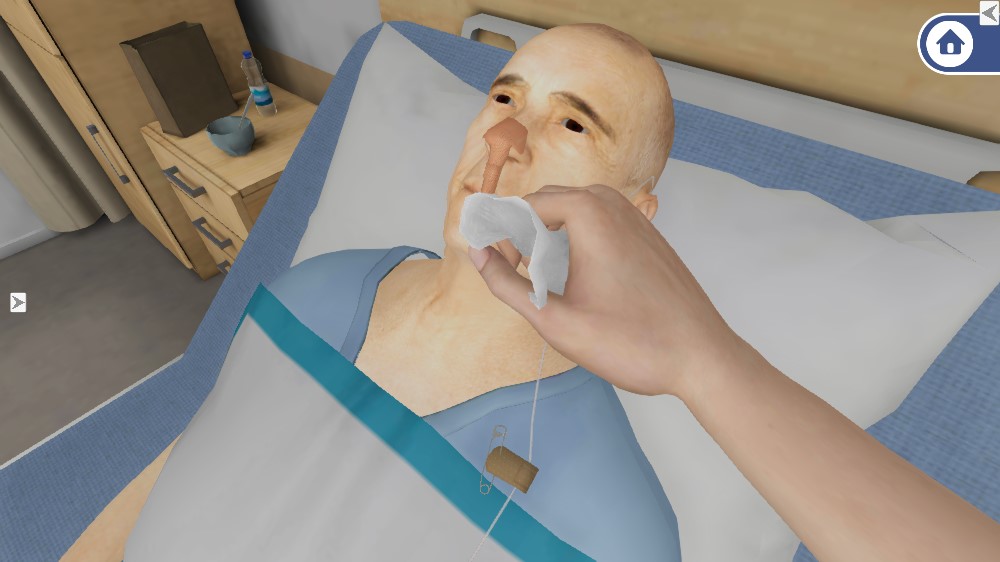
Then clean the nose and fix the probe with a (nasal fixation) plaster. Check that the probe stays in place when swallowing and when turning movements. Guide the probe behind the ear and attach the probe (if desired) to the clothing at chest level. Make sure that the probe can continue to move with head movements.
Then write down your procedure, the size and length of the inserted gastric tube, the pH determination, the date of insertion and any findings.
Would you like to put this entire step-by-step plan into practice? Then start now with CareUp! Through the 3D simulation game you can practice and test the insertion of a nasogastric tube very realistically.
Tube feeding and administering medication via tube
Administering tube feeding via tube
Before you administer tube feeding, you should always check whether the nasogastric tube is still in the stomach. You can do this in the following ways:
- Check the length of the probe coming out of the nose. Is it longer? Then the tube can no longer be in the stomach.
- Check if you can absorb gastric juice. If gastric juice comes up, the tube is still well in the stomach. (If no gastric juice comes up, this does not immediately mean that the tube is not in the right position, because the stomach can also be empty!)
If the pH value is less than or equal to 5.5, it is very likely that the probe is in the stomach. You can restart the power supply when the value is less than or equal to 5.5.
Administering tube feeding via tube
Medicines can only be administered via a tube if they can and may be finely ground. If this is not possible, a doctor or nurse should look for an alternative medicine. Medicines should never be mixed with tube feeding.
If you have to administer medication through the tube, the tube must be injected with lukewarm water both before and after administering the medication. If the medication has to be taken on an empty stomach, tube feeding must be temporarily stopped. Always discuss this with the doctor.
Flushing nasogastric tube
A nasogastric tube should be flushed about 4 to 6 times a day. This is important to prevent blockages. In any case, do the flushing before and after administering tube feeding and/or giving medication.
Complications with a nasogastric tube
Cough
If a client starts coughing continuously while administering tube feeding, stop administering tube feeding immediately. The probe may then end up in the trachea. Contact a doctor immediately.
Irritated nasal mucosa
The nasogastric tube runs through the nose, through the throat to the stomach. This can irritate the nasal mucosa. It is important to check the nose daily for irritation and any wounds. In case of irritation, you can apply petroleum jelly ointment to the inside of the nostril. In addition, it is recommended to change the nostril of the probe when the probe needs to be changed.
Constipation
We speak of constipation when you have not had a bowel movement for more than 3 days (or this should be your normal pattern). It may be that there is too little fiber in the tube feeding, or that you are not getting enough fluids. Medication use can also be a cause or too little exercise. If a client suffers from constipation, this should always be discussed with the doctor.
Diarrhoea
Sometimes someone can get diarrhoea when tube feeding. This is possible, for example, when the tube feeding is administered in too large portions. But also when the administration rate is too high, or when the food is too cold. In addition, medication can also have an influence. If the diarrhoea persists for more than 3 days, the doctor should always be contacted.

