
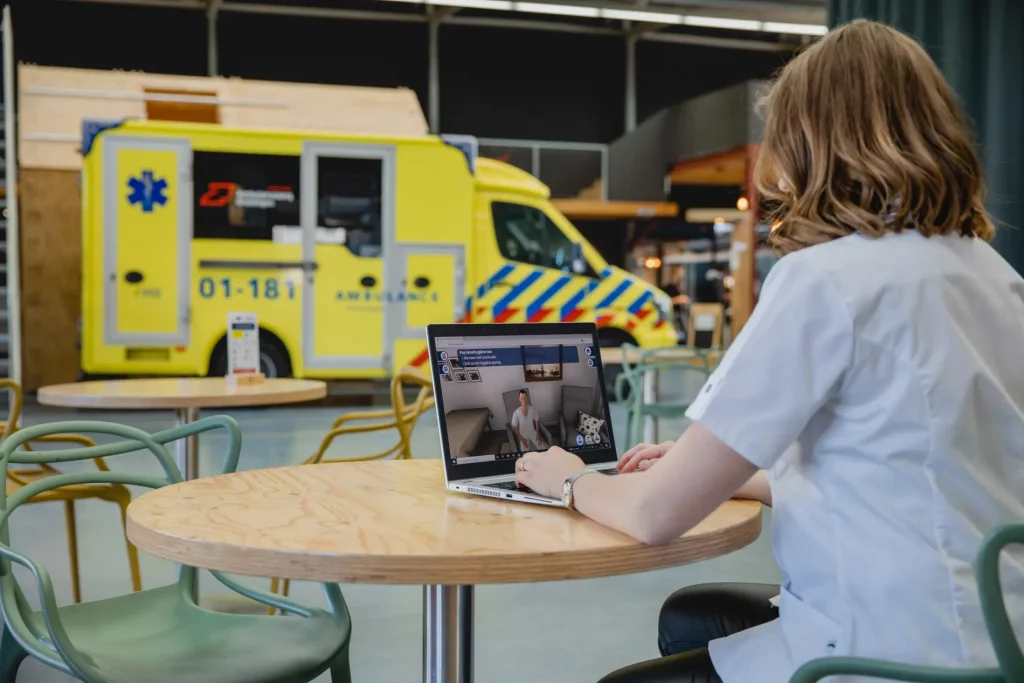
'Flight simulator for healthcare' increases guidance capacity
The Dutch Commercial Training Institute, ROC Midden Nederland, Utrechtzorg and TripleMotion Media are working on a ‘flight simulator for healthcare’. This allows students to practice care actions in an innovative way: the Virtual Learning Lab. Students are thus faster and better prepared for internships, without taking up the limited supervision capacity at the care institutions. A solution to the capacity problems in training in healthcare.
Various developments in society make it clear how great the pressure is on the healthcare sector and on the people who work there. For example, there is the aging population due to an increase in life expectancy, which means that a growing number of elderly people with chronic conditions and dementia are making use of care. There are also more single elderly people who live at home for longer. The new rules regarding social care and the consequences of the coronavirus have once again emphasized the urgency of the shortages in healthcare
Lack
This sharply increasing demand for care leads to an excessive workload among current healthcare workers. Even before the corona pandemic, a staff shortage of 80,000 employees was expected in the Netherlands in 2022 (Monitor Action Programme Working in Healthcare, 2019). In the Utrecht region, this translates into a shortage of approximately 3,300 healthcare workers in 2022 (UtrechtZorg, September 2019). At MBO level, this involves a shortage of 780 Caregiver-IG employees and 1,000 Nursing employees in 2022.
The workload in the healthcare sector is also growing due to the need for other competencies, such as dealing with new equipment and new forms of communication with clients through, for example, remote care. In addition, in adjacent sectors, such as social care and welfare, nursing knowledge and skills are also required. In short, the pressure to work more efficiently in healthcare is palpable. For the sector, the challenge is to work on optimal, sustainable employability of the healthcare professional within the limited time.
Flexible educational concept
To contribute to this, the Ministry of Health, Welfare and Sport has set itself the target of increasing the number of lateral entrants and returners to the healthcare sector by 20% each year. The use of lateral entrants in addition to the regular influx can not only make an important contribution to combating the staff shortage in the sector, but also reduce the workload of the current staff. To this end, ROC Midden Nederland and the Dutch Commercial Training Institute MBO College (NCOI) are working together on the so-called Virtual Learning Lab.
The Virtual Learning Lab is part of a flexible educational concept. This online platform enables students of the Nurturing IG training to learn and practice nursing knowledge, skills and attitude, regardless of time, place and the availability of teachers or practice supervisors. As a result, fewer healthcare personnel are needed for training. The focus is on practicing the nursing procedures as included in the Vilans protocol. By flexibly following individual parts of the training program when needed, the ROC and NCOI also want to contribute to the faster deployment of new staff.
The basis is an existing app, CareUp, which is being further developed into the desired Virtual Learning Lab. CareUp was developed by TripleMotion Media B.V. a few years ago for healthcare professionals and students in healthcare. The app is already in full use, both at healthcare institutions and schools, and can be downloaded on a mobile device. All Vilans protocols are available in CareUp. It is possible for healthcare professionals to obtain the necessary healthcare accreditation points via this app.
Lifelike
The CareUp app is being upgraded for the Virtual Learning Lab by making learning situations more lifelike. In addition, there will be more levels to practice with, ranging from a short instructional video for beginners, advanced and experts. There is also the possibility for tests. The spoken and written texts are screened at language level so that it is suitable for every student from MBO level. For more information, you can take a look at the demo here.
An important goal of the Virtual Learning Lab is for students to practice with scenarios that correspond to real-life situations. For example: your pager goes off while you are performing a nursing procedure.
Jos van Leeuwen, director and owner of TripleMotionMedia: “It is important to learn to respond to these situations. The Virtual Learning Lab contains multiple scenarios, suitable for multiple target groups. CareUp is also suitable for qualified healthcare workers who need to remain competent. Quality of care must be guaranteed. This collaboration and the CareUp product contribute to this.” At the end of April, there was a test day with the Virtual Learning Lab, where teachers and healthcare workers looked at a first version. One attendee responded: “The VLL is a good preparation for practice. By playing this app, you can already store the nursing procedure in your memory.”
The “new learning” occupies an important place in the Virtual Learning Lab. By adding game elements, the Lab challenges students to continue practicing the care protocols. Lecturers and internship supervisors can show that they are involved with their students by sending (encouraging) messages via the app.
Do not replace
An important part of the Virtual Learning Lab is ‘sustainable assurance’ so that the Lab remains up-to-date even after the project has been completed. There will be a periodic user consultation with the supplier. There is also a budget available for future changes and wishes.
The teachers and internship supervisors will receive an explanation of how the app works and how it can be used properly in lessons and practical internships. Where possible, existing initiatives with regard to care, technology and innovation will be linked as much as possible. We will continue to draw attention to this professionalization of teachers and internship supervisors, also in the future.
Wouter Hommes, Manager of Educational Innovation & Innovation at NCOI: “Of course, the Virtual Learning Lab cannot replace practice. But thanks to this technique, students can get to grips with the routines and it is a small step to practice. Especially because all actions are based on the Vilans protocols.” Jos van der Eijk, Director of the Healthcare College of ROC Midden Nederland: “This collaboration between ROC Midden Nederland and NCOI is of course inspiring and, in this area, also urgent. It’s nice to see how we put our shoulders to the wheel together.”
Future
Article is taken from Qruxx: https://www.qruxx.com/flightsimulator-voor-de-zorg-vergroot-begeleidingscapaciteit/

