
In this article
Articles in this category
Administering medication safely
Safely administering medication is a very important skill for healthcare professionals. Many mistakes are made when using medicines. In addition, there are many ways in which medication can be administered, depending on the type of medication, the effect and the condition of the client.
5 Basic rules for administering medicines
Here are the five basic rules for safely administering medications:
- Right medication: check carefully whether you have the right medication.
- Right client: check that you are not accidentally giving another client’s medication. Grabbing the wrong box is quickly done under high time pressure.
- Right time: know when to administer the medication. For example, before or after dinner or in the morning or in the evening. In addition, the times when you give the medicine must of course be well spread throughout the day.
- Correct way of administering: make sure you know how and where to administer the medicine. Because the operation can change significantly if you do it the wrong way.
- Correct dose: misread the comma? Or instead of 10 milligrams I gave 10 grams? You may think you’ll never make that mistake, but it happens anyway! Therefore, always check once more whether the dose is correct.
Are you aware of the latest rules of the Vilans protocols for administering medication to a client? Make sure you are competent, but above all competent in administering medicines. Test and test your knowledge directly online via the CareUp Virtual Learning Lab, based on the Vilans protocols and you will also receive accreditation points for it!
Protocol for administering medication
There are various protocols for administering medication. The most well-known protocols in healthcare are the Vilans Kick protocols. These are the basic actions according to the Vilans Kick protocols for giving medicines:
- Clean your hands and your work surface;
- Check that you have all the equipment you need ready;
- Check whether the five basic rules are correct: right client, right time, right medicine, right time, right way of administration and right dose;
- As a healthcare provider, avoid direct skin contact with the medicine. Put on gloves if necessary;
- Administer the medication correctly;
- First clean your hands when you are done, then the work field and then your hands again;
- Sign off the administration list so that your colleagues can see that the medication has been administered.
Convinced? Start now with CareUppen!
In what ways can you administer medication?
Medication can be given in different ways. For example, medicines can be administered orally, rectally, sublingually, intravenously, intramuscularly or subcutaneously. As a healthcare professional, you not only need to know when to administer which medication, but also how to administer the medication.
Inhaling medicines
In the case of respiratory problems, medication is often administered through the airways. This can be done via atomizers, nebulizers and powder inhalers. COPD (asthma) patients mainly take medications that need to be inhaled.
The advantage of inhaling (inhaling) the medicines over giving tablets, for example, is that through inhalation the medication comes directly to the place where they are needed: in the lungs. In addition, bronchodilators work within 5 to 10 minutes and cause fewer side effects than tablets.
Administering oral medication
The best-known way to take medication is orally. Pills and tablets are often taken by mouth. This medication is then absorbed through the mucous membranes. For example, through the oral mucosa, the cheek mucosa or the mucous membranes in the intestines.
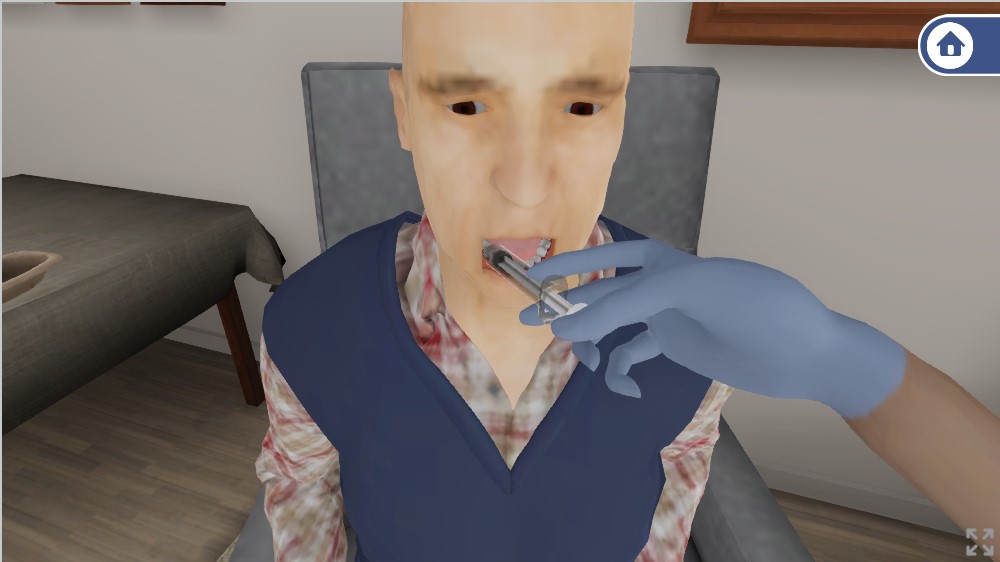
You can also administer medication orally through a syringe in the cheek pouch. This is often done to ensure that the medicine is taken properly and not spit out, for example in the elderly and children.
Administering rectal medication
When medicines have to be administered rectally, the medicines are introduced into the body through the anus. This often happens in children, but also, for example, when someone cannot take pain relief orally due to nausea. The most well-known example is the suppository.
Sublingual drug administration
Sublingual administration of drugs means that the drug is placed under the tongue. This is often used for medication that needs to be absorbed quickly or when medication should not be affected by stomach acid.
Do you know the protocol for performing this action? Practice and test the sublingual administration of medication via the online 3D simulation game, based on Vilans Kick protocols. This way you can be sure that you are competent and competent in administering medicines.
Sublingual drug administration
Sublingual administration of drugs means that the drug is placed under the tongue. This is often used for medication that needs to be absorbed quickly or when medication should not be affected by stomach acid.
Do you know the protocol for performing this action? Practice and test the sublingual administration of medication via the online 3D simulation game, based on Vilans Kick protocols. This way you can be sure that you are competent and competent in administering medicines.
Administering transdermal medications
With transdermal administration, the medication is administered through the skin. Patches are often used for transdermal drug delivery, an example is the fentanyl patch. But cream and ointment are also examples of transdermal medication.
Administering intravenous medications
When medication is to be administered intravenously, the medication should be injected directly into the vein. This is often done with antibiotics, so that it enters the bloodstream directly and is absorbed into the body more quickly.
Administering intramuscular medications
An intramuscular injection is the administration of medication through an injection into the muscle tissue. Muscle tissue is well supplied with blood and absorbs medication quickly. The most commonly used muscles for this are the gluteal muscle, the deltoid muscle (upper arm) and the thigh muscle. An example of medication that is injected into the upper outer buttock quadrant is vitamin B12.
Administering subcutaneous medications
The subcutaneous insertion of medicines means that medicines must be inserted under the skin, for example via an injection. The most well-known medication that is given subcutaneously is insulin injections.
Subcutaneous administration of medication can be done with a butterfly needle (also called a butterfly needle) and via an insuflon.
A butterfly needle can remain in place for a short period of time (a few days). It is important that the area where the butterfly is located does not become infected.
An insuflon is an injection port (or residence port) with a cannula made of Teflon. The advantage of administering a drug via an insuflon compared to a regular needle is that the skin is less likely to become irritated. An example of a subcutaneous injection is giving fraxiparin to prevent thrombosis.
Do you know how to give a subcutaneous injection? Practice and test this action via the 3D simulation game based on the Vilans Kick protocols.
Administering medication via tube
If someone cannot swallow or chew properly, you can also administer medication through a tube. Placing a probe is a risky procedure that may only be performed on the order of a licensed physician.
When medication has to be administered through the tube, the medication is dissolved in water so that the medication can easily pass through the tube.
Download our FREE brochure to read how our virtual skills lab CareUp can help you!
Forgot to give medication?
A mistake can happen and forgetting to administer medication is one of the most common mistakes, no matter how careful you are. Will you find out quickly? Then you can still administer the medication.
If it is almost time for the next dose, you just continue according to the schedule and leave the ‘forgotten medication’ for what it is. Never give a client a double dose!
Some medicines state separately what to do if a dosage is forgotten.

